


2026 Australian Grand Prix Race Review: Russell Leads Mercedes 1-2 in Melbourne

George Russell won the 2026 Australian Grand Prix ahead of Kimi Antonelli and Charles Leclerc as Mercedes nailed strategy in Melbourne. Full race analysis, tyre strategies, pace, pit stops, top speeds and key takeaways.
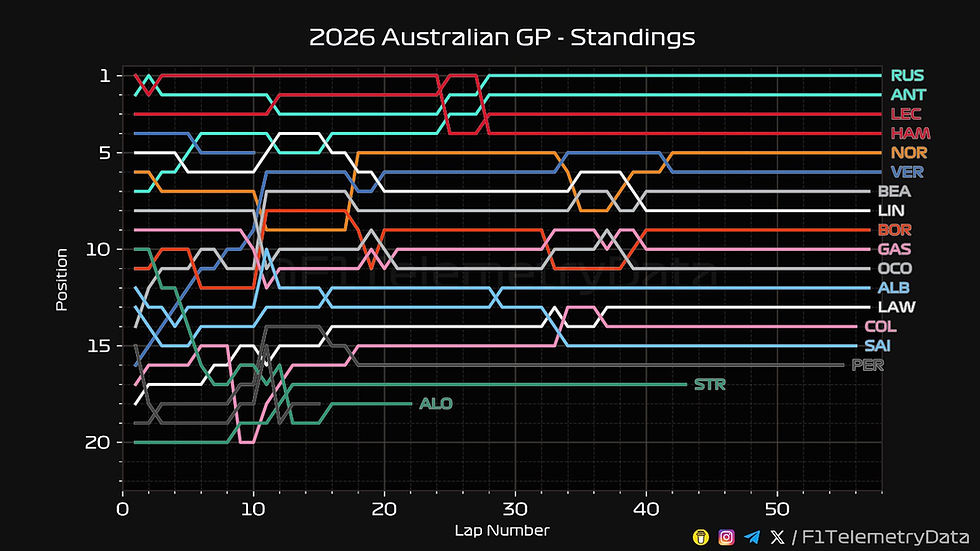
George Russell converted pole into victory at Albert Park, leading home team mate Kimi Antonelli for a Mercedes 1-2 finish, while Charles Leclerc completed the podium for Ferrari. It was a race shaped by early battles at the front, Virtual Safety Car timing, and one of the biggest strategic questions of the weekend: pit early and trust the hard tyre, or stay out and protect track position?
Mercedes chose correctly, and that decision defined the race.
Russell won in 1:23:06.801, finishing 2.974 seconds ahead of Antonelli, with Leclerc 15.519 seconds back in third.
Lewis Hamilton was fourth in the second Ferrari, while Lando Norris completed the top five for McLaren. Max Verstappen recovered from 20th on the grid to sixth and also set the race’s fastest lap with a 1:22.091.
Official top 10 – 2026 Australian Grand Prix
George Russell – Mercedes
Kimi Antonelli – Mercedes
Charles Leclerc – Ferrari
Lewis Hamilton – Ferrari
Lando Norris – McLaren
Max Verstappen – Red Bull
Oliver Bearman – Haas
Arvid Lindblad – Racing Bulls
Gabriel Bortoleto – Audi
Pierre Gasly – Alpine
How the race was won

From the start, this did not look like a simple lights-to-flag win for Mercedes.
Leclerc jumped forward aggressively and took the lead from Russell in the opening phase, and Ferrari looked ready to fight for more than just a podium.
But the race swung when the Virtual Safety Car appeared after Isack Hadjar stopped on track. Mercedes reacted by pitting both Russell and Antonelli, committing to the one-stop route, while Ferrari stayed out. That split the race into two different strategic stories.
A second VSC after Valtteri Bottas retired added even more tension. Ferrari again stayed out longer, hoping fresher tyres later in the race would bring them back into play. Instead, Mercedes managed tyre life well enough to make the one-stop work, and Ferrari never closed the gap decisively enough to force the Silver Arrows into another stop.
Russell controlled the final phase, Antonelli backed him up brilliantly, and Mercedes walked away with maximum satisfaction from the season opener.
Mercedes’ big advantage: strategy plus execution
The race result tells one story. The charts tell the deeper one.
From the tyre strategy image, both Russell and Antonelli ran the same winning structure: Medium to Hard, pitting on Lap 12 and then going all the way to the finish on the hard compound. That is a massive final stint at Albert Park and shows Mercedes had both confidence in tyre durability and the pace to protect that decision. This was the defining tactical move of the race.
Ferrari split its plan slightly differently. Leclerc started on mediums and stopped on Lap 25, while Hamilton stayed out even longer and pitted on Lap 28, both switching to hards. That gave Ferrari more flexible tyre age later in the race, but not enough track position to beat Mercedes when it counted.
McLaren and Red Bull were also interesting cases. Norris went Medium-Hard-Medium, stopping on Laps 11 and 34, while Verstappen did the reverse of the McLaren approach: Hard-Medium-Hard, stopping on Laps 18 and 41. That helped explain why Verstappen could recover strongly through the field and why Norris had to defend hard in the closing stages.
Race pace analysis: who was actually fastest?

The official result says Mercedes was best. The race pace boxplot adds another layer and suggests that over the full race distance, Antonelli and Russell were the class of the field, with Ferrari close but not quite enough, and Red Bull and McLaren more variable.
The pace chart places Antonelli and Russell at the front of the median race-pace picture, with Hamilton and Leclerc close enough to stay relevant, but not close enough to overturn the strategic disadvantage. Norris and Verstappen both showed competitive pace in phases, yet neither had a clean enough race shape to challenge the Mercedes pair for victory.
That fits the official story. Formula 1’s race report described Mercedes as making the one-stop work to perfection, while Ferrari’s alternative approach never generated enough late-race pressure.
See here the F1 2026 Standings updated after the 2026 Australian Grand Prix
Top speeds: the straight-line surprise stories
One of the most interesting details is the top speed ranking.

According to the top-speed graphic, Franco Colapinto recorded the highest speed at 343 km/h, ahead of Esteban Ocon on 342 km/h and Gabriel Bortoleto on 340 km/h. Verstappen was at 337 km/h, while the Mercedes drivers were lower down on 334 km/h.
That matters because it suggests Mercedes did not win by simply being the fastest in a straight line. They won through a better overall package: qualifying pace, race control, tyre management and strategy execution. Ferrari looked competitive. Red Bull had flashes. But Mercedes looked the most complete.
Qualifying set the platform
Russell’s win did not come from nowhere. He had already laid the foundation on Saturday.
The Mercedes driver took pole with a 1:18.518, ahead of Antonelli’s 1:18.811, giving the team a front-row lockout. Hadjar qualified third, Leclerc fourth, Piastri fifth and Norris sixth, with Hamilton seventh. That meant Mercedes began Sunday with the cleanest strategic options available.
The most important qualifying-to-race story was how much the order changed behind the front row. Verstappen had started deep in the field after a poor Saturday and still recovered to sixth, while Antonelli turned second on the grid into second at the finish despite the pressure of a season opener under brand-new regulations.
Ferrari: close enough to encourage, not close enough to win
Ferrari had genuine reasons to believe it could win this race.
Leclerc led early, and both Ferrari drivers stayed in the fight for a long time. Hamilton finished just 0.625 seconds behind Leclerc, which also suggests Ferrari’s two drivers were operating at a very similar level across the race. But the strategic calls left both cars behind the Mercedes duo after the VSC phases, and from there Ferrari was chasing instead of controlling.

For Ferrari fans, that is both frustrating and promising. Frustrating because the pace looked real. Promising because the team was clearly in the fight at the first race of a major regulation reset.
McLaren and Red Bull: fast in moments, incomplete overall
Lando Norris finished fifth and scored important points for McLaren, but the bigger story was the team losing Oscar Piastri before the race even started, after he spun off while heading to the grid. That left McLaren with only one car and destroyed what could have been a stronger tactical race.
For Red Bull, it was a split day in the extreme. Hadjar qualified third but retired after 10 laps, while Verstappen salvaged the weekend with sixth and the fastest lap. That recovery from 20th to sixth was one of the standout drives of the day, even if the final result still underlined that Red Bull did not have the clean, dominant package it would have wanted for the opening round.
Standout midfield stories: Bearman, Lindblad and Audi
The opening race of a new era always creates breakout performances, and Melbourne had several.
Oliver Bearman took seventh for Haas, which was a strong reward for a disciplined race. Arvid Lindblad scored points on his Formula 1 debut with eighth, a hugely impressive result in difficult conditions and under fresh regulations.
Gabriel Bortoleto gave Audi ninth place and its first points of the new campaign, while Pierre Gasly grabbed the final point for Alpine.
That group matters because the midfield in 2026 already looks tight. A clean strategy and a tidy race can turn into a massive result immediately.
Pit stops and execution
Pit times chart shows another piece of the race puzzle.

Ferrari had the fastest average pitlane time at 17.95s, ahead of McLaren (18.14s) and Racing Bulls (18.66s), while Mercedes averaged 19.71s. Aston Martin was slowest at 29.78s. That tells us Mercedes did not win because of the absolute quickest service time. They won because they pitted at the right moment and built the race around the VSC windows better than Ferrari did.
That is an important distinction. Raw pit-stop speed is useful. Strategic timing is what wins races.
Reaction times and the opening launch phase

The reaction times graphic adds an interesting start-line angle. It shows Carlos Sainz as the fastest to 200 km/h at 5.7s, while several drivers clustered in the 3-second range for the first 100 km/h segment.
These launch metrics help explain some of the position changes in the early laps, even if the race’s long-term result was shaped more by VSC timing and tyre life than by the initial getaway alone.
Full race classification context
A few more official result details matter for the wider season narrative:
Russell scored 25 points for the win.
Antonelli took 18 points for second.
Piastri and Hulkenberg were listed as DNS.
That means Mercedes leaves Melbourne with the strongest possible team message, while Russell also exits Australia as the early championship leader. Reuters and other race reports noted the result as Mercedes’ first Albert Park win since 2019, which adds to the sense that this was more than just a good Sunday — it was a statement.

What the 2026 Australian Grand Prix tells us about the season ahead
This race did not answer every question about the new Formula 1 era, but it did answer a few important ones.
First, Mercedes is immediately a real title threat. The team had pole, race-winning pace, and the confidence to commit to a bold tyre plan.
Second, Ferrari is close enough to fight, but needs to be sharper strategically.
Third, McLaren and Red Bull still have speed, but their weekends already showed how costly one mistake, one retirement, or one compromised Saturday can be in a tightly packed field.
And finally, the midfield is alive. Bearman, Lindblad and Bortoleto all gave their teams meaningful reasons to believe that 2026 could be far more open than many expected.
For a season opener, Melbourne gave Formula 1 exactly what it wanted: a race with strategy, pace variation, recovery drives, rookie impact, and a clear but not overwhelming early pecking order.
Mercedes won the first battle. The war looks wide open.
Who won the 2026 Australian Grand Prix?
George Russell won the 2026 Australian Grand Prix for Mercedes, finishing ahead of team mate Kimi Antonelli and Ferrari’s Charles Leclerc.
What was the key strategy in the 2026 Australian Grand Prix?
The key move was Mercedes stopping both Russell and Antonelli under an early Virtual Safety Car and committing to a one-stop strategy, which ultimately decided the race.
Who got pole position for the 2026 Australian Grand Prix?
George Russell took pole position with a 1:18.518 for Mercedes.
Who set the fastest lap in the 2026 Australian Grand Prix?
Max Verstappen set the fastest lap of the race with a 1:22.091 on Lap 43.
Did Kimi Antonelli finish on the podium in Australia 2026?
Yes. Kimi Antonelli finished second for Mercedes in the 2026 Australian Grand Prix.
What happened to Oscar Piastri in the 2026 Australian Grand Prix?
Oscar Piastri did not start the race after spinning off while heading to the grid before the Grand Prix began.

Comments