


2026 Japanese Grand Prix Analysis: How Antonelli Won, Why Russell Struggled, and What Suzuka Revealed

The 2026 Japanese Grand Prix was another reminder that the final classification rarely tells the full story. Suzuka delivered an explosive opening lap, a race-shaping Safety Car, major position swings, and a clear demonstration of just how much clean air still matters in modern Formula 1.

Kimi Antonelli may have taken the win, but the road to victory was anything but simple. George Russell had the pace to finish much higher than fourth. McLaren showed signs of being a genuine threat. Nico Hulkenberg quietly produced one of the strongest recoveries in the midfield. And once again, dirty air played a major role in deciding who could actually use their speed.
Antonelli turned a terrible start into a dominant win
Coming into Suzuka, Antonelli already had momentum and pole position, but his race nearly unraveled immediately when the lights went out. He lost five positions at the start, turning what should have been a controlled run from the front into a recovery drive through traffic. Russell also lost ground, dropping two places, while Audi suffered one of the weakest launches on the grid, with Gabriel Bortoleto losing four positions and Hulkenberg losing six on lap one.

What makes Antonelli’s win so impressive is that he not only recovered from that poor getaway, but eventually became untouchable. Once the race reset and he found clear air, nobody was able to match him. He built a gap of around 13 to 14 seconds at the front and looked in complete control by the closing stages.
This was not a lucky victory. It was a race won through recovery pace, overtaking, and control once the opportunity opened up.
The Safety Car changed everything at Suzuka
The biggest incident of the race came around lap 21 when Bearman crashed heavily, triggering the Safety Car. That moment effectively defined the strategic shape of the Grand Prix. Later retirements for Lance Stroll and Alex Albon added more attrition, but the Safety Car was the event that truly changed the race.

Before that intervention, there was still room for strategy to diverge. Tyre life looked manageable, and some drivers may have been able to extend their first stints. Instead, the timing of the Safety Car dropped most of the field directly into the ideal pit window, flattening the race into a largely uniform one-stop contest.
That one moment removed much of the strategic creativity that Suzuka might otherwise have offered.
McLaren’s pace was one of the biggest positives from the weekend
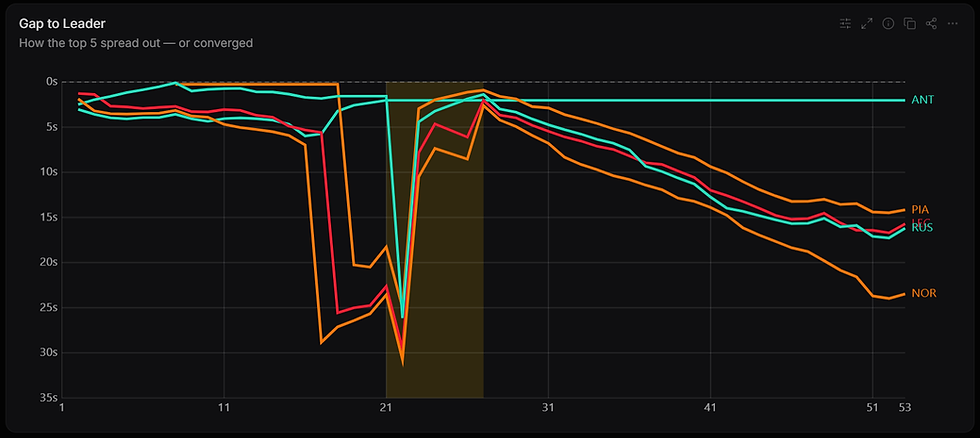
One of the clearest takeaways from the 2026 Japanese Grand Prix was that McLaren had real speed. Oscar Piastri led early and looked especially strong during the first stint on medium tyres. His pace was good enough that he was gaining over Russell late in that stint, and without the Safety Car there was every reason to think McLaren could have been in an even stronger position later in the race.
That matters because Suzuka is a demanding circuit where good pace is difficult to fake. McLaren did not just inherit track position or benefit from chaos. The underlying speed looked genuine, especially on mediums, and that should be an encouraging sign heading into the next phase of the season.

Russell had the pace for more, but dirty air ruined his race
George Russell’s result is one of the clearest examples of how race pace and finishing position can tell two very different stories. On outright speed, he looked strong enough to finish second. In reality, he came home fourth after spending large parts of the race trapped in traffic and losing time behind the Ferraris.

That is where dirty air becomes so important. The race analysis breaks the running into several zones: within one second of the car ahead, one to two seconds, two to four seconds, and clear air beyond that range. Russell, along with Norris and Hamilton, spent very little of the race in genuine clean air. Each saw only around six to eight percent of the Grand Prix without a car ahead disrupting performance.
Russell spent much of the race in the heaviest turbulence, especially while sitting behind the Ferraris and watching their battle unfold in front of him. At Suzuka, that was enough to turn a potential second-place pace profile into a frustrating fourth-place finish.
Dirty air shaped the entire field
The dirty air picture was not just about Russell. Hulkenberg’s race is a great example of how traffic can completely change a driver’s afternoon. After his disastrous opening lap, he dropped behind slower cars and had almost no clean air at all. Even when he overtook, he often found himself immediately behind another car. Despite that, he recovered brilliantly to finish P11 after regaining the six places he lost and adding two more.

Antonelli’s race told the opposite story. His first stint featured a lot of traffic as he carved back through the field, but once he moved beyond the Ferraris and into clean air, the race changed completely. The same pattern could be seen with Piastri, whose best pace came when he was not stuck in turbulence.
At the front and in the midfield, Suzuka underlined the same truth: clear air is still one of the most valuable assets in Formula 1.
Strategy was simple, but it could have been more interesting
Strategically, the race was mostly straightforward. Twenty-one of the 22 drivers started on medium tyres with the expectation of a one-stop race onto hard tyres. Bottas reversed that pattern by starting on hards.
The interesting point is that there were signs more options could have opened up without the Safety Car. Bottas was able to run 32 laps on the medium tyre, which suggests there may have been room for longer first stints or even more aggressive late-race tyre choices had the race stayed green.
Instead, the Safety Car simplified everything. Once the field stopped together, variation largely disappeared and the race became much more dependent on restart execution, clean air, and overtaking ability.
Hamilton and the pit crews delivered strong execution
There was not a huge amount of pit lane drama, which usually means the crews did their jobs well. Hamilton recorded the best total pit lane time at 22.9 seconds and may also have had the fastest stationary stop, around 2.1 seconds. Perez, Alonso, and Doohan were among the slower outliers.

That kind of operational sharpness matters more than ever in races where strategic differences are limited. When everyone is on similar tyre plans, execution in the pit lane becomes one of the few remaining ways to gain track position.
Lawson gained the most positions, while others slipped back
From grid to finish, Liam Lawson was the biggest gainer, making up five places over the course of the race. Verstappen and Alonso each gained three positions, although Alonso’s gains were helped in part by retirements ahead. At the other end of the scale, Hadjar, Bortoleto, and Doohan each lost four positions by the chequered flag.

These swings add another layer to the Suzuka story. Some drivers made the most of the race’s disruptions, while others never recovered from early setbacks.
Race pace vs finishing position shows who overperformed
One of the most useful ways to understand the 2026 Japanese Grand Prix is by comparing each driver’s raw race pace to where they actually finished.
Antonelli had the fastest race pace and won, so his result matched the speed underneath it. But behind him, there were several major mismatches. Piastri’s race pace ranked around fourth, yet he finished second. Leclerc’s pace profile looked closer to seventh, yet he finished third. Russell’s speed was good enough for second, but he ended up fourth. Norris also finished higher than his pure pace ranking suggested. Hamilton, meanwhile, had a stronger pace than his final result reflected.

That makes Suzuka a great example of how execution, traffic, timing, and racecraft can reshape the order beyond what the stopwatch alone would predict.
Suzuka’s overtaking hotspots told their own story
The battle map also revealed where overtakes and close fights were happening around the track. Mercedes looked strongest toward the end of the straights, likely helped by efficient battery deployment and strong top-end speed. Ferrari, by contrast, looked more dangerous in the corners. Overall, Turn 1 appeared to be one of the best overtaking zones, especially through the apex and exit.

That helps explain several of the race’s notable duels. Russell could attack in one phase of the lap, but Ferrari often had the tools to defend or strike back in another. Verstappen’s fight with Gasly showed something similar, including a move that briefly worked before being reversed.
Teammate gaps revealed some early season patterns
Teammate race pace comparisons from Suzuka also highlighted some bigger trends. Mercedes, Ferrari, and McLaren looked relatively close internally, with McLaren especially tight. Red Bull showed a much larger split between drivers, and Alpine displayed a similar pattern. Audi and Williams were comparatively close, while Aston Martin and Cadillac still look to be searching for consistency.

These are still early-season signals, but Suzuka added another useful reference point in understanding which teams are extracting performance across both cars and which ones are leaning heavily on one driver.
Final thoughts on the 2026 Japanese Grand Prix
The 2026 Japanese Grand Prix was not just about who won. It was about how the race unfolded and why certain drivers could or could not convert pace into results.
Antonelli recovered from a terrible start and then dominated once he reached clear air. McLaren showed pace that should worry its rivals. Russell had the speed for much more but never got the race conditions he needed. Hulkenberg quietly delivered one of the strongest recovery drives in the midfield. And across the field, Suzuka once again proved that dirty air, traffic, and timing remain race-defining factors in modern Formula 1.
If the opening races of 2026 are setting the tone for the season, then this championship is going to be decided by far more than raw speed alone.


Comments