


Slower Than Every F2 Car: Aston Martin's Baku Top Speed Problem in Numbers

Aston Martin's Baku weekend produced one of the most-shared stats of the 2026 season: on the 2.2 km main straight, both AMR26s were slower than every single car in the Formula 2 field. We dug into the numbers to see how big the gap really was, what explains it, and why it matters for this weekend at Sepang.
The numbers: 22 F2 cars, two Aston Martins at the bottom
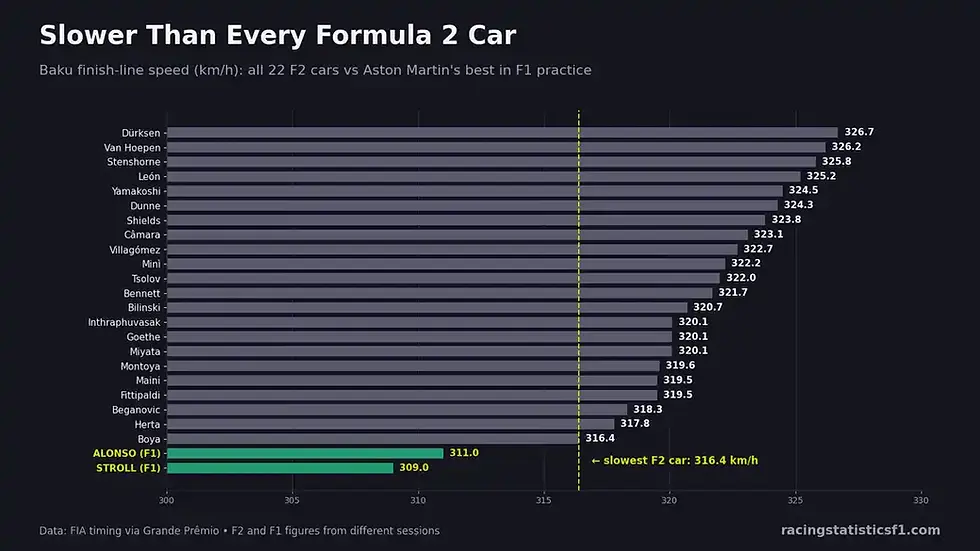
At the finish-line speed check, Fernando Alonso recorded 311.0 km/h and Lance Stroll 309.0 km/h in Thursday practice. The slowest F2 car in qualifying, Mari Boya, was measured at 316.4 km/h, which is 5.4 km/h faster than Alonso. At the top of the F2 list, Joshua Dürksen reached 326.7 km/h, a gap of 15.7 km/h to Alonso and 17.7 km/h to Stroll.
But not slower over a lap
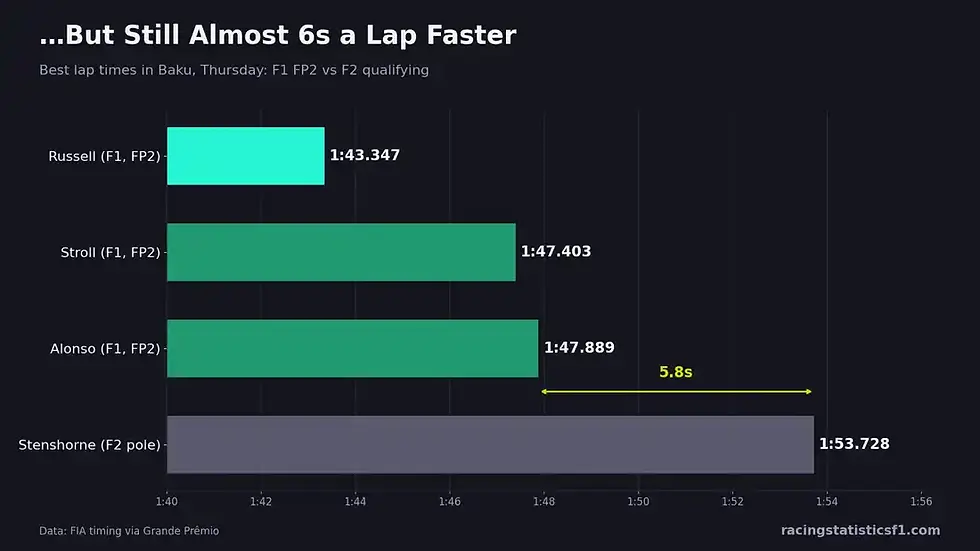
Top speed is only one part of a lap. Alonso's FP2 best of 1:47.889 was still 5.8 seconds quicker than Martinius Stenshorne's F2 pole time of 1:53.728. What the speed data does show is where Aston Martin lost its time to the rest of F1: Stroll was 4.056 seconds off George Russell's 1:43.347 in FP2, and Baku's long flat-out section is where a big part of that went.
Why this comparison needs an asterisk
Several factors mean this isn't a perfect like-for-like comparison:
Different sessions: the F2 figures come from qualifying, the Aston Martin figures from F1 practice.
Slipstream: a tow is worth a lot on Baku's straight, and F2 drivers actively hunt for one in qualifying.
Practice programmes: F1 teams use practice to try different rear-wing levels, fuel loads and energy deployment, and don't always run their strongest engine modes.
Measuring point: these are finish-line speeds, not the true maximum reached at the end of the straight.
Even so, all 22 F2 cars beating both Aston Martins can't be explained away by one lucky tow. Under the 2026 rules, close to half of a car's power comes from the electrical side, so how well a car harvests and deploys energy matters most on very long straights like Baku's. Honda had warned before the weekend that Baku would be particularly demanding for exactly that reason, and the numbers suggest a mix of limited deployment and high drag.
How fast is Baku supposed to be?
Baku has produced some of the highest speeds in Formula 1 history. In 2016 qualifying, Valtteri Bottas was clocked at 366.1 km/h at the speed trap in his Williams with a tow from Max Verstappen. This year, the fastest speed-trap figure of the race belonged to Racing Bulls' Liam Lawson at 349.4 km/h. Speed-trap figures are measured at a different point from the finish line, so treat them as context rather than a direct comparison.

How the weekend ended for Aston Martin
The straight-line deficit showed up in the results. Alonso qualified 19th and Stroll 21st, both cars were sent to the back of the grid after power-unit changes, and both retired from the race with separate problems.
What to watch at Sepang
Sepang is a different kind of test, with fast corners where downforce matters more than on Baku's streets. But its two long straights will show whether Aston Martin and Honda have found any of the missing speed, and we'll be watching the speed traps closely from FP1. Follow every session with our F1 live watchalong, with live timing, telemetry and data-driven commentary.
Data: FIA timing as reported by Grande Prêmio, Las Motorsport and Motorsport.com.


Comments