


2026 Miami GP Qualifying Analysis: Antonelli Bounces Back With Pole, Four Teams in Top Four — Full Telemetry Breakdown

Hours after a sprint race that exposed his start weakness and cost him a penalty, Kimi Antonelli walked back into the Miami International Autodrome on Saturday evening and delivered one of the most composed pole laps of the 2026 season. Antonelli set a 1:27.798 in Q3 to beat Max Verstappen by 0.166 seconds, with Charles Leclerc third for Ferrari and sprint pole sitter Lando Norris fourth for McLaren. For the first time this season, four different teams occupy the first four grid positions — and the telemetry data explains exactly how each one got there.
Miami GP Q3 Starting Grid
Pos | Driver | Team | Q3 Time | Gap |
P1 | Kimi Antonelli | Mercedes | 1:27.798 | Pole |
P2 | Max Verstappen | Red Bull | 1:27.964 | +0.166s |
P3 | Charles Leclerc | Ferrari | 1:28.143 | +0.345s |
P4 | Lando Norris | McLaren | 1:28.183 | +0.385s |
P5 | George Russell | Mercedes | 1:28.197 | +0.399s |
P6 | Lewis Hamilton | Ferrari | 1:28.319 | +0.521s |
P7 | Oscar Piastri | McLaren | 1:28.332 | +0.534s |
P8 | Franco Colapinto | Alpine | 1:28.762 | +0.964s |
P9 | Isack Hadjar | Red Bull | 1:28.789 | +0.991s |
P10 | Pierre Gasly | Alpine | 1:28.810 | +1.012s |
Bortoleto (Audi) disqualified from sprint race earlier for engine intake pressure violation; brake fire ended his Q1 run.
Miami GP Starting Grid

The grid sets up what promises to be one of the most unpredictable Miami Grand Prix races in years. The result sets up a fascinating Miami GP, with four different teams inside the top four and Antonelli facing pressure from Verstappen, Leclerc and Norris into Turn 1. With rain threatening on Sunday and all four front-runners carrying fundamentally different car philosophies — as the telemetry data below shows — the strategy permutations are enormous.
Notable absentees from Q3 include both Williams drivers: Sainz ended Q2 in P14, and Albon — already frustrated all weekend — was heard expressing his displeasure over the radio after missing out in P16. Audi had their most difficult session yet: Hulkenberg missed Q3, and Bortoleto's brake fire in Q1 stopped his lap entirely, just hours after being disqualified from the sprint result for an engine intake air pressure violation.
Qualifying Lap Delta: Antonelli's Emphatic Response

The lap delta chart tells the story of a genuinely competitive top seven, then a cliff-edge to the midfield. The standout detail is how closely bunched P1 through P5 are: the top five are separated by just 0.399 seconds — a remarkable compression of performance for a grid of 22 cars running fundamentally different aerodynamic philosophies.
Verstappen's +0.166s to Antonelli is the closest any Red Bull driver has been to a front-running competitor all season. Verstappen's late improvement put Red Bull on the front row for the first time this season, confirming that the team's Miami upgrade package has moved the RB22 closer to the leading group. The Macarena wing plus floor upgrade is clearly delivering across both sprint and grand prix qualifying formats.
Norris at +0.385s and Russell at +0.399s are just 0.014 seconds apart — the gap between McLaren P4 and Mercedes P5 being essentially negligible. Norris needed to deliver from an underwhelming ninth, and he managed to gain a couple of positions to end Q2 in P7 before a strong final run hoisted him to fourth. The McLaren upgrade package that dominated sprint qualifying was slightly less dominant in grand prix qualifying trim — suggesting Mercedes found something between sessions.
At the other end, Bortoleto's +5.939s is entirely explained by his brake fire in Q1 preventing a proper flying lap — his underlying pace from the sprint suggests the Audi is genuinely much closer to the midfield than this number implies.
Qualifying Lap Compare: Antonelli Dominates Two of Three Sectors
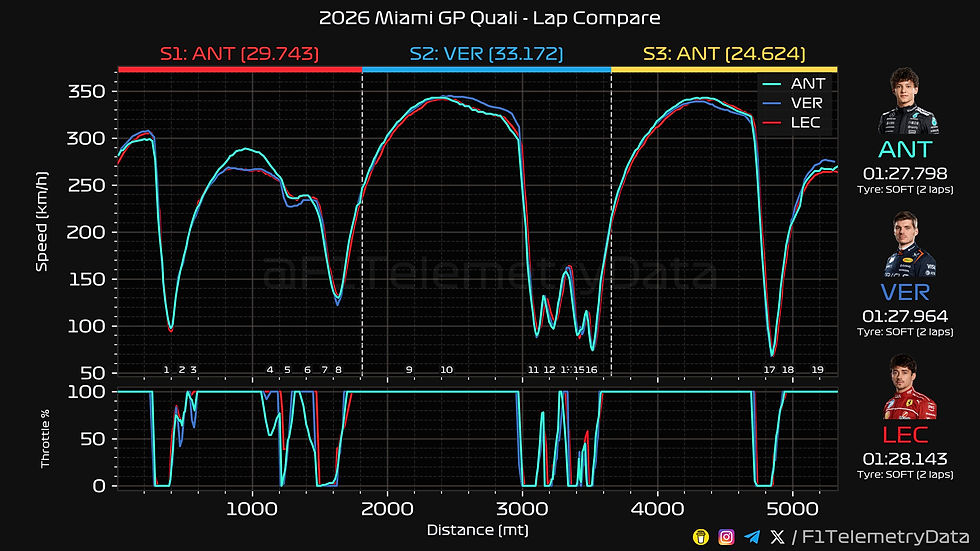
This is the most revealing chart in the qualifying dataset. Unlike the sprint, where Norris's S1 dominance was the decisive factor, qualifying was defined by Antonelli's two-sector supremacy. The young Italian won Sector 1 (29.743s) and Sector 3 (24.624s) — the technical opening complex and the fast final sequence — while Verstappen took only Sector 2 (33.172s), the high-speed middle portion where Red Bull's straight-line efficiency advantage is at its most potent.
The speed trace shows Antonelli carrying exceptional apex speed through the S-bends at corners 4 through 7 — not a corner or two, but an entire sequence where the cyan Mercedes line sits consistently above both the Verstappen blue and Leclerc red. This is the Mercedes W17 in its element: high-efficiency, high-average-speed aerodynamics that allow the car to flow through connected corners without needing to sacrifice straightline pace.
What makes Antonelli's lap particularly impressive is that he pulled these margins while also leading the full-throttle percentage stakes (see Lap Sections below), meaning the car wasn't just fast in corners — it was also early and aggressive on power. "It's been an amazing day, to be on pole again," said Antonelli. "It was obviously a difficult start of the day with the Sprint, where it didn't go our way, but I'm super happy with the recovery."
Leclerc at 1:28.143 was 0.179 seconds behind Antonelli despite Ferrari leading the throttle usage chart for the entire weekend. The SF-26's limitations in Sector 2 — where it trails Verstappen by 0.167 seconds — continue to be the car's principal qualifying weakness.
Qualifying Track Dominance: Antonelli's Cyan Everywhere

The circuit map makes Antonelli's pole lap visual. Cyan covers almost the entire track — the opening infield complex, the chicane sequences, and critically the final sector where the W17's aerodynamic efficiency pays dividends as the car accelerates through the last corners before the start-finish straight.
Verstappen's blue section appears through the long Sector 2 straight portions — Turns 9 through 13 — where the RB22's Macarena wing delivers its maximum drag reduction benefit and the Red Bull's 345 km/h top speed outpaces Antonelli's 343 km/h. This 2 km/h straight-line advantage is real, but the Mercedes driver's corner speed advantage across the rest of the circuit is simply larger.
Leclerc's red flickers appear at two or three specific corners — places where the SF-26's mechanical grip and Leclerc's trail-braking technique briefly outshine the Mercedes and Red Bull. But they are isolated islands in a sea of Antonelli cyan, a visual representation of why pole was never realistically in doubt for the Mercedes once the Italian delivered his first Q3 lap cleanly.
Qualifying Lap Sections: Hamilton's Extraordinary 0.9% Lift

If there is one number from the entire Miami weekend that deserves its own headline, it is Lewis Hamilton's 0.9% lift percentage in qualifying. This is lower than Leclerc's famous 1.1% from FP1 that we highlighted on Friday. For reference, Verstappen is at 6.5% and Antonelli at 5.3%. Hamilton is spending virtually the entire qualifying lap either braking, on partial throttle, or fully committed to power — with almost no "lift" phase at all.
This driving style — deep trail-braking transitioning directly to throttle — is astonishingly aggressive and explains how Hamilton ended up P6 at +0.521s despite Ferrari leading the throttle usage chart by a significant margin. With a cleaner lap — he reportedly suffered a gearbox-related issue during his Q3 run — the telemetry suggests Hamilton could have challenged for the third row, or potentially higher.
Verstappen's 59.3% full throttle is the highest of the three pole-contenders, confirming what Friday's data showed: the RB22 upgrade package is enabling unprecedented levels of deployment in qualifying trim. This is the Red Bull at its most effective straight-line state all season. Hamilton's 59.9% full throttle edges even Verstappen — making him the most aggressive throttle user of the top six, full stop.
Antonelli's 17.5% braking time is the highest of the group — a sign that the Mercedes driver is committed to very late braking zones, a technique that maximises the car's strong mechanical grip under deceleration and transitions naturally into the W17's high-efficiency cornering stance.
Qualifying Throttle Usage: Ferrari Lead, McLaren Surprisingly Low

The throttle usage chart delivers one of the weekend's most surprising findings. Ferrari leads the entire field at 59.2% — higher than Mercedes (54.0%) and, strikingly, higher than Red Bull (58.0%) which had topped the sprint qualifying chart. This means the SF-26 is spending more time at full power than any other car on the grid, an extraordinary figure for a team that started the 2026 season fighting ERS integration and deployment timing issues.
The explanation lies in Ferrari's aggressive power unit mapping for qualifying. The SF-26 carries the highest downforce level of the front-running teams — confirmed by the downforce map below — which means it scrubs off speed in corners but can deploy electric power earlier and for longer on corner exits. The result is a very high full-throttle percentage driven by early, extended deployment rather than pure straight-line efficiency.
McLaren's 52.9% — notably lower than their sprint qualifying figure — reflects a slightly different setup for the grand prix format. The MCL26 was trimmed with marginally less downforce than in the sprint, allowing slightly higher corner exit speeds but reducing the time spent at peak deployment. This explains why Norris fell from sprint pole to GP qualifying P4: the car's sprint-focused package was its strongest configuration this weekend.
Alpine's 48.0% is the lowest of all teams — they are running a downforce configuration that requires more partial-throttle time through corners, sacrificing immediate deployment for cornering balance.
Qualifying Top Speeds: Verstappen Fastest, Bortoleto Brake Fire Anomaly

The qualifying top speed chart confirms Red Bull's straight-line supremacy: Verstappen leads at 345 km/h, matched by Gasly, Hadjar and Colapinto — all running comparatively low downforce configurations. The fact that Verstappen reaches 345 km/h while still being 0.166 seconds off Antonelli's pole time locates Red Bull's deficit precisely: it is in cornering performance, not straight-line speed, where the gap to Mercedes exists.
The surprising name near the bottom is Hamilton at 338 km/h — the lowest top speed of any Ferrari, Mercedes or McLaren driver. This is consistent with the qualifying lap sections data showing Hamilton's ultra-aggressive driving style: by braking so late and carrying so much corner speed, he is accessing the straights at a later point and with different power deployment timing, resulting in a lower peak trap speed despite spending more time at full throttle than anyone else in the top six.
Bortoleto's 318 km/h is an anomaly — not a reflection of the Audi's actual pace, but of a lap that ended abruptly with brake fire before he could reach the circuit's fastest section. His underlying qualifying pace from the weekend suggests the Audi is capable of reaching the 342–343 km/h range in normal conditions.
Qualifying Downforce Map: Mercedes Highest Efficiency, Ferrari Boldest Setup

The qualifying downforce map shows some significant movement from the sprint qualifying chart. Red Bull and Alpine now share the top-right high-efficiency zone — both teams combining strong average circuit speed with high top speeds, a position that reflects their low-drag setup philosophy for the grand prix format. For Red Bull in particular, this is the clearest confirmation yet that the Macarena wing is delivering its intended benefit: more speed everywhere, not just in a straight line.
Mercedes sits just below that cluster — still very efficient, still fast in a straight line, but with a slightly higher downforce balance than Red Bull or Alpine. This is the W17's natural operating point, and it is clearly still the most balanced package on the grid.
Ferrari has moved to a higher-average-speed position than McLaren — an interesting reversal from the sprint qualifying chart — suggesting they trimmed some downforce for the longer grand prix format. McLaren has moved toward more balanced territory too, no longer sitting in the extreme high-downforce corner of the map.
Aston Martin remains stubbornly isolated in the bottom-left: low average speed and low top speed simultaneously. Without new parts and with a car that generates excessive drag, there is no aerodynamic configuration that can rescue their position on this chart.
Qualifying Teammate Gaps: Alpine Tightest, Haas a Disaster

The teammate gap chart for qualifying delivers some fascinating intra-team narratives. Alpine are the most evenly matched pair on the grid at just 0.048 seconds between Colapinto and Gasly — both in Q3, both delivering strong sessions, both representing Alpine's best collective qualifying performance of the 2026 season. The A524's upgrade package appears to be working symmetrically for both drivers.
Ferrari's 0.176-second gap between Leclerc and Hamilton is the closest the two have been all weekend, and significantly tighter than the 0.379s from sprint qualifying. Hamilton's extraordinary driving style data — that 0.9% lift figure — suggests he extracted maximum performance from the SF-26 within the constraints of a difficult Q3 run. Strip out Hamilton's reported gearbox issue on his final lap, and this gap may have been even smaller.
McLaren's 0.317 seconds Norris-over-Piastri gap reflects an afternoon where the MCL26's GP qualifying setup slightly dulled Piastri's edge versus his teammate. The Australian ended P7 — four places behind Norris — despite being just 0.017s off sprint qualifying pole in SQ3 the previous evening.
Red Bull's 0.825 seconds between Verstappen and Hadjar remains the largest of the competitive teams, though down from the 0.961s sprint qualifying gap. Hadjar continues to struggle integrating with the upgraded RB22.
The Haas 4.092-second gap between Hulkenberg and Bortoleto is entirely due to the Audi driver's brake fire curtailing his Q1 lap — not a meaningful performance difference.
Qualifying Year on Year: Ferrari Closest to 2025, Williams Improving

The year-on-year qualifying comparison shows a tighter overall picture than the sprint equivalent — all teams within 3.5 seconds of their 2025 Miami qualifying times, compared to the extraordinary 13.54-second sprint deficit for Aston Martin that we saw on Friday.
Ferrari lead the recovery at just +1.39 seconds versus 2025 — the strongest adaptation to the 2026 regulations of any team at this circuit in qualifying trim. Their 11-upgrade package in Miami has clearly produced measurable results, and their 59.2% throttle usage confirms they are extracting more from the new power unit rules than any other manufacturer.
Mercedes (+1.53s) and Alpine (+1.58s) follow closely — both teams having found strong balances between the new regulations' demands. The 0.19-second gap between Alpine and Red Bull (+1.76s) in year-on-year terms is a striking endorsement of the French team's 2026 concept: they are closing the gap to the top faster than Red Bull despite having fewer resources.
McLaren at +1.91s is the most interesting data point. Despite having the fastest sprint qualifying lap of the entire weekend and winning the sprint race, McLaren's grand prix qualifying deficit to 2025 is larger than Ferrari, Mercedes, Alpine and Red Bull. This confirms what the setup data has been showing all weekend: McLaren's upgrade package is optimised for the sprint format — high downforce, high cornering speed, strong tyre performance over 19 laps. For the 57-lap grand prix, where slightly different compromises are required, the MCL26's advantage shrinks.
Aston Martin's +3.49s is far less dramatic than the sprint's +13.54s, which was partly explained by the extraordinary circumstances of their sprint session. In qualifying trim, the AMR26's deficit is simply very large — not historically catastrophic. They remain the grid's slowest car, but there is at least a floor of competitiveness in the data that suggests the team is not quite as adrift as Friday evening implied.
Grand Prix Race Preview: Four Teams, One Turn 1
With Antonelli on pole and three different teams directly behind him, Sunday's Miami Grand Prix Turn 1 promises to be the most consequential moment of the 2026 season so far. Leclerc was displaced by the Dutchman at the last second and will line up third on the grid alongside Norris. The outside of the second row is a genuinely threatening position at Miami's wide Turn 1, particularly given Norris's sprint-proven aggressive start technique.
Antonelli's key challenge is converting pole into a clean first lap — his third attempt at doing so in three different qualifying sessions this weekend. Toto Wolff stated the Mercedes team does not believe the start issue is driver error, but with two failed launches already in Miami, the pressure is enormous.
Verstappen from P2 is the most dangerous threat on pure race pace. His sprint race closing data on used mediums — fastest laps in the final stint — combined with Saturday's qualifying pace confirms the RB22 upgrade has produced a genuinely race-competitive car for the first time in 2026. A clean Turn 1 and Verstappen could lead the first stint.
Leclerc from P3 gives Ferrari their best grand prix starting position of the season. The SF-26's long-run pace from FP1 was matched with Mercedes, and their throttle deployment advantages suggest they can manage tyres aggressively. Hamilton from P6 adds a second threat from the Ferrari garage — potentially into the top three if the opening laps produce any incidents.
Rain is forecast for Sunday in Miami. If it arrives, all of the above analysis becomes secondary to who makes the correct tyre call at the right moment. Four teams with four genuinely different cars, four different tactical options, and a championship that is moving in new directions by the hour. Sunday cannot come soon enough.
You can watch F1 live miami race with us on youtube in our watchalong:


98win.com hôm trước mình thấy bạn bè nhắc nên bấm vào coi thử cho biết, kiểu xem giao diện thôi chứ không ngồi tìm hiểu sâu. Vừa vào là thấy trang nhìn khá sáng sủa, khoảng trắng vừa đủ nên không bị ngợp. Mình để ý cái menu đặt khá rõ ràng, chuyển qua lại vài chỗ mà không bị lạc, nhất là lúc mở trên điện thoại. Thông tin họ chia theo từng khối ngắn ngắn, lướt xuống là nắm được mình đang ở phần nào, không phải đọc cả đống chữ liền một mạch. Mấy bảng hiển thị cũng canh hàng thẳng, nhìn phát là hiểu chứ không rối mắt, nói chung bố cục gọn và menu nằm…
DN 88 mình vừa lướt qua đúng kiểu người dùng bình thường, chủ yếu xem họ bố trí trang với nội dung ra sao chứ không có thời gian tìm hiểu sâu. Cảm giác dễ chịu là mấy tiêu đề lớn đặt rõ, kéo xuống là biết đang ở mục nào, nên đọc nhanh vẫn theo kịp, không phải dừng lại đoán. Mình dùng điện thoại thử vài phút thì thấy chuyển mục khá trơn, các khối nội dung xếp gọn theo chiều dọc nên thao tác một tay cũng ổn. Có một đoạn nói về bảo mật và xử lý giao dịch được đặt khá dễ nhìn, nên dù mới vào vẫn thấy yên tâm hơn chút. Nói chung…
dk88 có dễ xài không nhỉ? Mình thử lướt qua thì thấy cũng ổn đó: kiểu họ làm bố cục đơn giản nên nhìn vào không bị rối mắt, mấy mục chính đặt khá rõ nên mình chỉ kéo nhẹ một vòng là biết chỗ nào là thông tin, chỗ nào là phần thao tác, khỏi phải mò trong nhiều lớp menu. Với lại cách họ trình bày nội dung theo từng khối, tiêu đề tách bạch ra nên đọc nhanh vẫn bắt được ý, nhất là mấy đoạn giới thiệu và hướng dẫn cơ bản không bị nhồi chữ liền tù tì làm mệt. Mình không rành mấy khoản cá cược đâu, chỉ thấy lướt qua lại giữa các…
MAX88 lúc đầu mình cũng hơi nghi ngờ kiểu “lại thêm một trang cho vui thôi chứ gì”, nhưng lướt thử vài phút thì thấy ổn hơn mình tưởng. Mình dùng như người bình thường, mở trên điện thoại là chính, nên chỉ quan tâm thao tác có nhanh không và tìm mục cần vào có dễ không. Điểm mình thích là giao diện chia khu vực khá rõ, bấm qua lại không phải mò lâu (mấy lúc đang rảnh lướt linh tinh mới thấy cái này đáng giá). Họ cũng nói kho sản phẩm nhiều, nghe thì hoành tráng, nhưng mình chưa kiểm chứng; cái mình để ý là bố cục dạng từng khối nội dung nhìn gọn, menu…
https://abcdebat.com/ làm mình nhớ mấy trang giải trí hồi trước mình hay ghé, kiểu mở ra là thấy họ cố gắng sắp xếp cho người mới đỡ rối; mình thì vẫn hơi nghi ngờ mấy chỗ tự nhận uy tín, nhưng lướt một vòng thấy cách họ chia nội dung cũng đàng hoàng, chữ không dồn dập quá nên đọc ổn; phần nói về bảo mật với giấy phép họ để ngay trong các khối thông tin riêng, nhìn cái là biết họ muốn người ta yên tâm, chứ không phải giấu ở đâu đó; menu đặt khá dễ thấy, chuyển qua lại mượt, ít phải đoán xem nút nằm chỗ nào; nói chung mình chưa dùng sâu nên không…